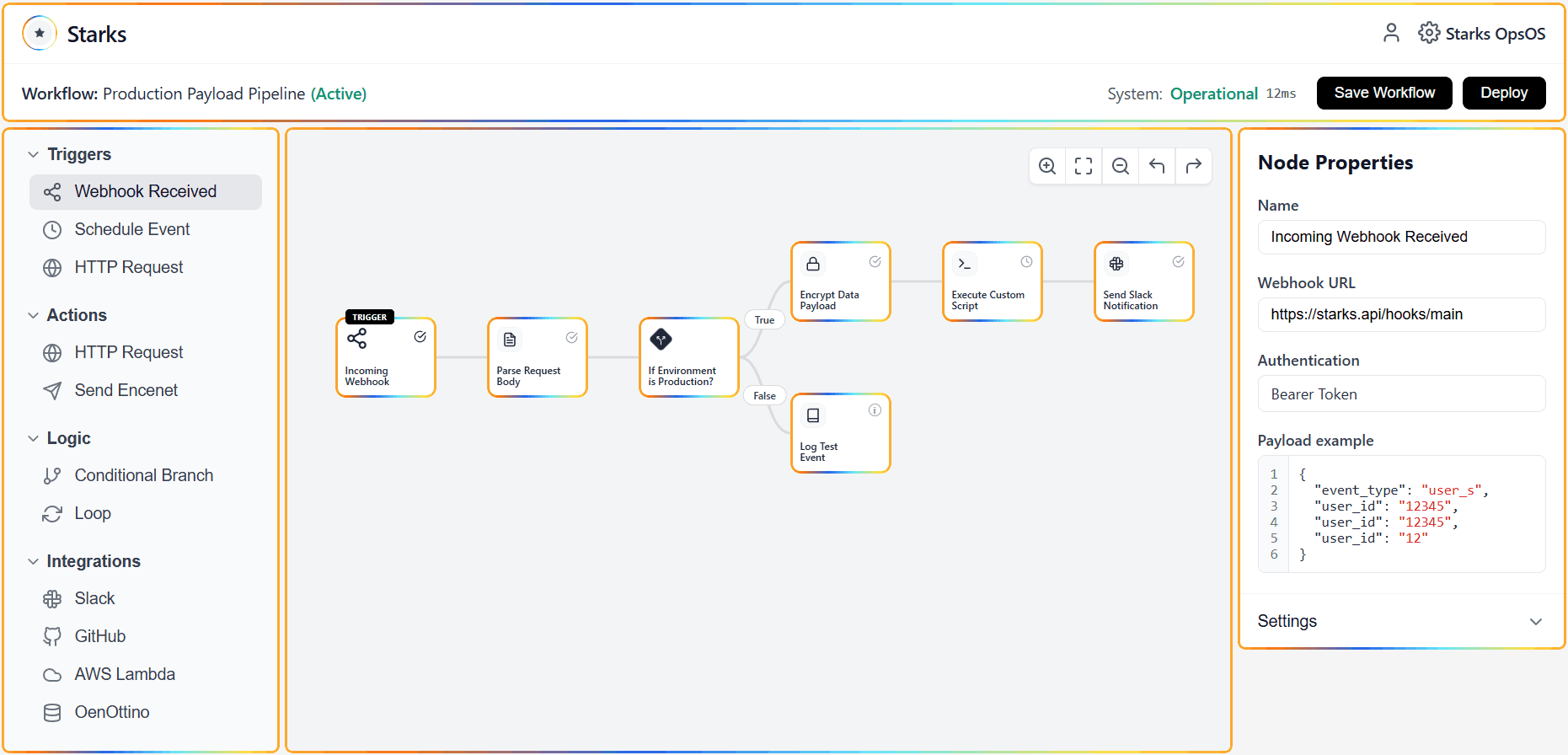
Building the fastest automation engine

Step 1: Low-Level Memory Management
Unlike traditional automation platforms built on interpreted languages, the Starks core is engineered using Rust. This allows us to achieve zero-cost abstractions and manual memory management, effectively eliminating the "garbage collection" pauses that cause jitter in high-frequency workflows. By compiling logic directly to machine code, we ensure that every trigger—no matter how complex—executes with raw, native performance.
Step 2: Distributed Edge Runtime
We have moved the execution layer away from centralized data centers and onto a global Edge Network. By utilizing V8 Isolates, Starks spin up execution environments in under 5ms. This "warm-start" technology ensures that your automation is running before a traditional serverless function would even finish initializing its environment.
Step 3: Non-Blocking I/O & Concurrency
Our custom-built async runtime handles thousands of simultaneous network requests without blocking the main execution thread. This is critical for workflows that involve multiple API handshakes or heavy data transformations, allowing for seamless parallel processing that scales vertically without increasing latency.
Strategic Operational Impact:
The result is a zero-latency environment that transforms how enterprises handle real-time data. By reducing the "execution-to-action" window, Starks allows for high-frequency trading, real-time fraud detection, and instantaneous system responses that were previously impossible in a standard SaaS stack.
See More
Expert advice on scaling operations and engineering workflows with absolute clarity.